Whey Protein Powder: How to Pick the Right One

Whey protein is the most studied, most widely sold protein supplement on the market, yet most buyers pick a tub based on price and flavour alone. The right whey formula depends on how well you digest dairy, how close you train to your meals, and what you actually need per serve. Here is how to tell one type from another and choose the one that fits your situation.
Key takeaways
- Whey comes in three forms: concentrate, isolate, and hydrolysate. Each has a different protein percentage, lactose content, and price point.
- Isolate is the right choice for most lactose-sensitive people; hydrolysate is rarely worth the premium for recreational athletes.
- A good whey label shows at least 20 g of protein per serve with minimal fillers, added sugars under 3 g, and a clear source declaration.
- Grass-fed claims carry some nutritional benefit (higher CLA content) but are not essential for muscle building goals.
- Third-party testing matters more than brand reputation when heavy metals and label accuracy are your concerns.
What is whey protein and where does it come from?
Whey is one of two proteins in cow's milk (the other is casein). It separates from the curd during cheese making and is then filtered, dried, and powdered. Because it contains all nine essential amino acids and digests faster than most protein sources, it became the benchmark for post-workout nutrition. Its leucine content, the amino acid that triggers muscle protein synthesis, is higher gram-for-gram than almost any plant-based alternative.
What are the three types of whey and which should you choose?
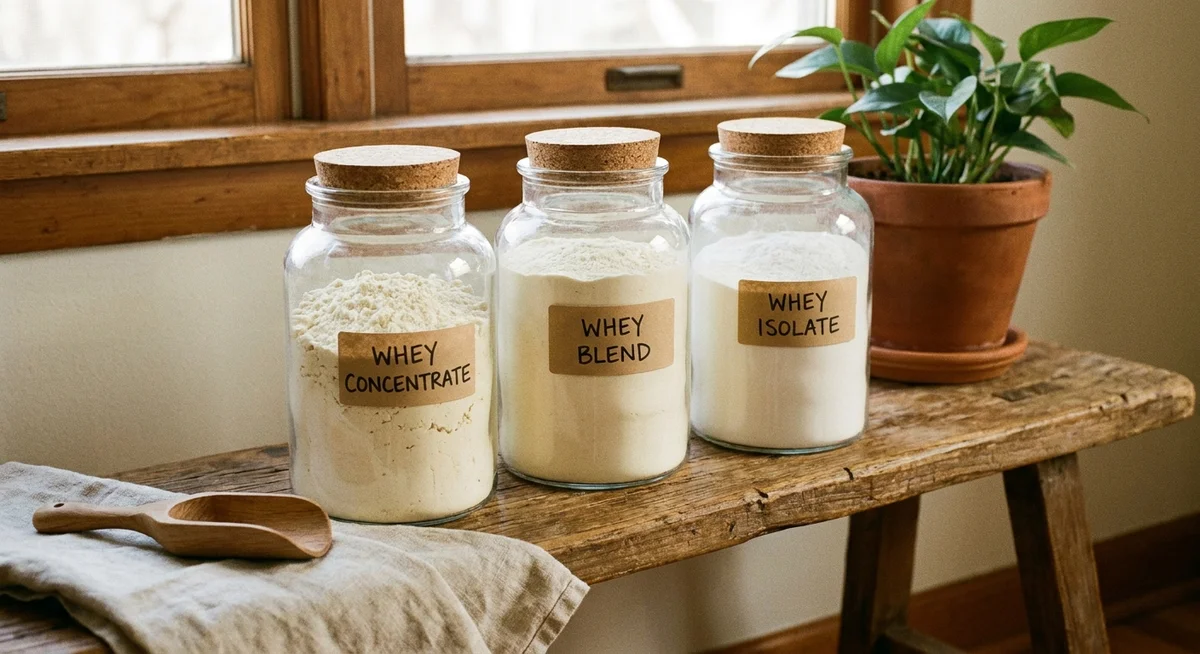
The processing method determines how much protein, lactose, and fat ends up in each scoop. Here is how the three forms compare.
| Type | Protein per 100 g | Lactose | Price (relative) | Best for |
|---|---|---|---|---|
| Concentrate (WPC) | 70–80 g | Moderate (3–5 g/serve) | $ | Budget buyers with no dairy sensitivity |
| Isolate (WPI) | 90–95 g | Very low (<1 g/serve) | $$ | Lactose-sensitive people, those cutting calories |
| Hydrolysate (WPH) | 90–95 g | Very low | $$$ | Clinical recovery; minimal practical edge for most gym-goers |
Concentrate is the least processed form. It retains more of the natural growth factors and immunoglobulins found in milk and costs the least. If your stomach handles dairy fine, a quality WPC is a perfectly solid choice. The lower protein density simply means you may need a slightly bigger scoop to hit your target.
Isolate goes through additional filtration (usually cross-flow microfiltration or ion exchange) to strip out most of the lactose and fat. The result is a higher protein percentage per scoop and a formula that sits much easier for people who get bloating from concentrate. If you are managing lactose intolerance, isolate is the practical starting point before moving to plant-based options.
Hydrolysate is pre-digested, meaning the protein chains are broken into smaller peptides before you even open the bag. Research shows it absorbs slightly faster than isolate, but the practical muscle-building difference for recreational athletes is negligible. The noticeably bitter taste and high price make it a specialist product, not an everyday one.
How do you read a whey protein label properly?
The nutrition panel tells you far more than the front-of-pack marketing does. Run through this checklist before buying.
- Protein per serve: Aim for at least 20 g per serve, ideally 24–27 g. Anything below 18 g per serve is usually diluted with fillers or flavouring agents.
- Serving size: Some brands inflate the scoop size to make protein numbers look impressive. Check grams of protein per 100 g, not just per serve. A quality isolate should show 88–95 g per 100 g.
- Added sugars: Under 3 g per serve is reasonable for a flavoured product. More than 5 g usually signals heavy use of maltodextrin or sucrose to mask bitterness.
- Sodium: Up to 200 mg per serve is normal. Significantly more can indicate poor quality filler ingredients.
- Ingredient list: The shorter, the better. Whey (or whey isolate), a flavour system, sweetener, and an emulsifier like sunflower lecithin is a clean, honest formula.
For a deeper walkthrough of what every line on the panel means, see our guide on how to read a protein powder nutrition label.
Reasons to choose whey
- Complete amino acid profile with high leucine content
- Fast digestion suits post-workout timing
- Decades of research behind efficacy and safety
- Wide flavour range and easy to mix
- Often the most cost-effective protein per gram
Reasons to look elsewhere
- Unsuitable if you avoid all animal products
- Concentrate can cause bloating in sensitive people
- Quality varies widely between budget brands
- Some formulas use high amounts of artificial sweeteners
- Not appropriate during severe dairy allergies (not just lactose)
Does grass-fed whey actually matter?
Grass-fed dairy does produce milk with a better omega-3 to omega-6 ratio and higher conjugated linoleic acid (CLA) content. Those differences survive processing to a degree. However, the quantities involved are small enough that if your goal is muscle protein synthesis, the source of the whey matters far less than hitting your daily protein target consistently. Grass-fed is worth choosing if you care about farming practices or want every marginal nutritional edge. It is not worth paying double for it if budget is tight. Understanding how much protein you actually need per day will do more for your results than the pasture the cows grazed on.
What about third-party testing?
Heavy metals (lead, cadmium, arsenic) and inaccurate protein labelling are the two most documented problems in the supplement industry. Third-party certifications like Informed Sport, NSF Certified for Sport, or HASTA (for Australian athletes) mean an independent lab has tested the product for both contamination and label accuracy. These certifications do not guarantee a perfect product, but they reduce the risk meaningfully. If you compete in sport under a testing body, an Informed Sport or NSF certification is non-negotiable.
Frequently asked questions
Is whey protein safe to take every day?
Yes, for healthy adults. Whey is a food-derived protein and long-term daily use at normal doses (20–40 g per day) has not been associated with harm in people with healthy kidneys. If you have existing kidney disease or compromised kidney function, speak with your doctor before adding any high-protein supplement to your diet.
Can women take whey protein?
Absolutely. Whey does not cause hormonal imbalances or unwanted bulk in women. It supports the same muscle protein synthesis processes regardless of sex. Dose, training load, and overall calorie intake determine outcomes, not the protein source. Our guide to protein powder for women covers this in more detail.
What is the difference between whey protein and a mass gainer?
A mass gainer contains whey (or another protein source) plus a large amount of carbohydrates, often from maltodextrin, to push the calorie count up to 500–1,000 per serve. A standard whey powder typically sits between 100 and 150 calories per serve. If your goal is adding body weight in a calorie surplus, a mass gainer can be convenient. If you want protein support without the extra carbohydrates, plain whey is the better fit.
How long does an open tub of whey protein last?
An opened tub stored in a cool, dry place away from direct sunlight typically stays fresh for six to twelve months after opening, well within the printed best-before date. Heat and moisture are the main enemies: avoid storing the tub near a stove, in a hot car, or in a humid bathroom. Check our guide on storing protein powder in summer heat for practical tips.
See our vanilla protein powder guideEverything you need to know before buying a vanilla whey formula in Australia.