Protein Powder and Hormones: How Protein Affects Testosterone, Estrogen, and Growth Hormone

Your protein intake does more than build muscle tissue. It acts as a direct signal to the hormonal systems that govern how your body grows, stores fat, and recovers from training. Get it right and your hormones work with you. Get it wrong and even a solid training program struggles to produce results.
Key takeaways
- Adequate protein supports testosterone production by supplying the raw materials for anabolic hormone synthesis.
- Very low-protein diets suppress growth hormone signalling and reduce IGF-1, the key mediator of muscle repair.
- Soy protein contains phytoestrogens, but research shows normal serving sizes do not meaningfully raise estrogen in most people.
- Protein source and total daily intake both matter. Whey and plant proteins produce slightly different hormonal responses.
- Timing protein around sleep can amplify the overnight growth hormone pulse that drives tissue repair.
Does protein intake affect testosterone levels?
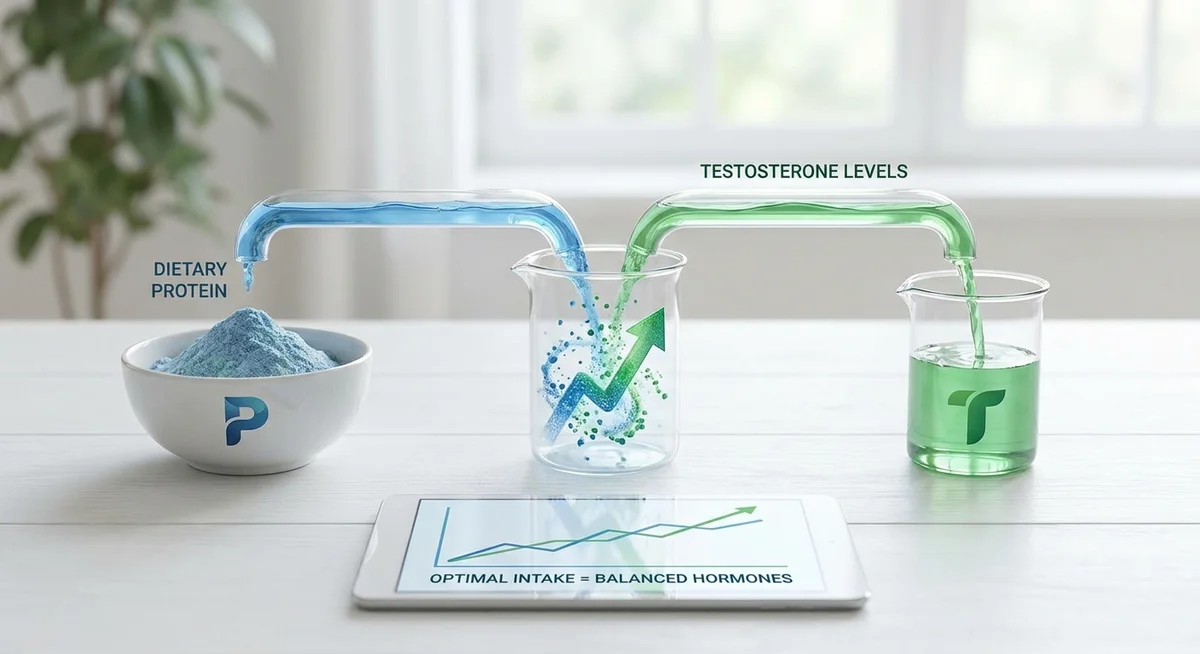
Yes, and the relationship cuts in both directions. Studies consistently show that men on very low protein intakes (below 1.2 g per kg of bodyweight) tend to have lower circulating testosterone than those eating adequate amounts. Testosterone is synthesised from cholesterol, but the broader hormonal environment, including insulin sensitivity and luteinising hormone output, is sensitive to total dietary adequacy, and protein plays a central role in that.
A well-cited 1987 study in the Journal of Steroid Biochemistry found that men who shifted from a high-protein to a low-protein diet saw a measurable drop in free testosterone within ten days. More recent research has confirmed that protein restriction impairs the hypothalamic-pituitary-gonadal axis, the hormonal chain that tells the testes to produce testosterone.
The practical implication is straightforward: hitting your daily protein target supports the hormonal environment for muscle growth. Chronically under-eating protein is not a neutral act. For people focused on building strength through weight training, this matters at a foundational level.
How does protein affect growth hormone and IGF-1?
Growth hormone (GH) is released in pulses, the largest of which occurs during deep sleep. It travels to the liver and triggers the production of insulin-like growth factor 1 (IGF-1), which is what actually drives muscle protein synthesis and repair at the cellular level. This system is protein-dependent in a specific way.
Research published in the American Journal of Clinical Nutrition found that protein restriction significantly reduces IGF-1 concentrations even when total calories are adequate. The liver needs dietary amino acids, particularly the branched-chain amino acids leucine, isoleucine, and valine, to produce IGF-1 in response to GH signals. Without them, the signal gets sent but the response is blunted.
This is why casein protein before bed has practical merit beyond simple muscle maintenance. A 40 g serving of slow-digesting casein sustains plasma amino acid levels across the overnight fast, giving the liver the substrate it needs during the period when GH output is highest. If you are older or focused on recovery, this matters more. Older adults especially benefit from optimising overnight protein delivery, since both GH output and anabolic sensitivity decline with age.
Does soy protein raise estrogen?
This is the most commonly misunderstood area of protein and hormones. Soy contains isoflavones, a class of phytoestrogens that can bind weakly to estrogen receptors. Because of this, many people assume soy protein will raise estrogen in men or disrupt hormone balance in women.
The current evidence does not support that concern for normal serving sizes. A 2010 meta-analysis in Fertility and Sterility reviewed 15 placebo-controlled studies and found that soy protein and isoflavone supplements did not alter testosterone or estrogen in men at typical intake levels (25-50 g of soy protein per day). Individual responses vary, and very high doses over sustained periods may have more effect, but one to two daily scoops of soy protein is not a meaningful hormonal disruptor in most people.
Women in perimenopause sometimes use soy isoflavones deliberately because the mild estrogenic activity can ease some symptoms. This is a legitimate use case, not a side effect to fear.
| Protein Source | Effect on Testosterone | Effect on Estrogen | Effect on IGF-1 |
|---|---|---|---|
| Whey (isolate or concentrate) | Neutral to positive when total intake is adequate | Neutral | Positive: high leucine content supports IGF-1 production |
| Casein | Neutral | Neutral | Positive overnight: sustained amino acid release during sleep |
| Soy | Neutral at standard doses | Mildly estrogenic at very high doses only | Similar to whey at matched leucine levels |
| Pea / Rice blend | Neutral | Neutral | Slightly lower than whey due to lower leucine density, offset by larger serving |
What total intake actually looks like in practice
For most adults in a training context, the hormonal benefits of protein plateau somewhere between 1.6 g and 2.2 g per kg of bodyweight per day. Eating beyond that does not appear to further boost anabolic hormone levels, though it does not suppress them either. The key is avoiding the low end, where hormonal downside becomes measurable.
If you are finding it hard to reach your daily target through food alone, supplementing with one to two scoops of a quality protein powder is a practical fix, not a shortcut. The protein powder buying guide walks through how to pick the right type for your specific goal so you are not just adding calories you do not need.
Protein distribution across the day also plays a role. Spreading intake across three to four meals, each containing at least 30-40 g, appears to keep IGF-1 and muscle protein synthesis elevated more consistently than front-loading or back-loading the same total amount. For most people that means protein at every main meal plus a post-training shake.
Find the right protein powder for your goalsBrowse Australia's top-rated options with full label transparency and honest guidance.Frequently asked questions
Can too much protein lower testosterone?
In the research, chronically very high protein intakes (above 3.5 g per kg) combined with very low fat intakes have been associated with some testosterone suppression, likely because dietary fat is needed for steroid hormone production. A balanced diet with adequate fat (at least 25-30% of calories) alongside high protein does not carry this risk. Most people eating normal mixed diets are nowhere near a problematic protein-to-fat ratio.
Does whey protein increase estrogen?
No. Whey is derived from dairy and contains no phytoestrogens. Some dairy products contain trace amounts of naturally occurring bovine estrogen, but the concentrations in whey protein, particularly isolate, are so small they have no documented effect on circulating estrogen in humans. This concern is not supported by clinical research.
Will protein powder affect my hormone levels if I'm a woman?
For most women, adding one to two daily servings of a standard whey or plant protein has no measurable effect on reproductive hormones. The exception is very high-dose soy supplementation sustained over months, which may produce mild estrogenic effects. At standard intake levels and with a varied protein source, there is no clinical reason for concern. Women focused on body composition benefit from adequate protein in the same way men do.
How does protein interact with cortisol?
High-intensity exercise raises cortisol, which is catabolic and can suppress testosterone temporarily. Adequate protein after training helps counteract this by providing amino acids that shift the body into a recovery state and support GH and IGF-1 activity. A post-workout shake consumed within one to two hours of training is one of the most practical tools for managing this cortisol-to-anabolic ratio. The full guide to protein and muscle recovery covers the post-training window in detail.