Protein Powder for Golfers: How to Build Power and Recover Between Rounds

Golf is a sport that asks your body for controlled power, sustained focus, and the ability to repeat the same athletic motion dozens of times in a row, often across multiple days. For club players and competitive amateurs alike, protein powder can be a practical tool to build the strength that adds distance, reduce soreness between rounds, and support the lean physique that helps you stay athletic into your 60s and beyond.
Key takeaways
- Golfers need protein to build the rotational muscle that drives distance, not just to recover from soreness.
- Aim for 1.6 to 2.0 g of protein per kg of bodyweight on training days; 1.4 to 1.6 g on rest and play days.
- Timing matters: a fast-digesting protein within 30 to 60 minutes post-round or post-gym session captures the recovery window.
- Whey isolate and plant-based blends are both effective; choose based on your digestion and dietary preferences.
- Avoid heavy shakes right before you tee off - stick to lighter options that won't sit in your stomach mid-swing.
Why do golfers need more protein than they think?
The golf swing is one of the most physically demanding single movements in sport. Peak rotational speed through the lumbar spine and hips is comparable to elite baseball, and generating that power consistently across 72 holes of a competition weekend puts real stress on your muscles, tendons, and joints. Add in the walking component (a typical 18-hole round covers 8 to 12 km) and the concentration demands of four-plus hours outdoors, and you have an athletic workload that most recreational players underestimate.
Protein supports two things that directly translate to better golf. First, it helps you build and maintain the muscle mass in your glutes, core, and upper back that generates clubhead speed. Second, it accelerates repair after the microtrauma your muscles absorb from a full round or a gym session, so you feel better and move more freely the next day.
How much protein do golfers actually need?
Most recreational golfers eat well below the protein intake that supports muscle development. General population guidelines suggest around 0.8 g per kg of bodyweight, but research on athletic populations consistently points to 1.6 to 2.0 g per kg as the range that supports muscle building and repair for people who train regularly.
For a 80 kg male golfer who hits the gym two or three times a week and plays one or two rounds on the weekend, that works out to roughly 128 to 160 g of protein per day. Hitting that figure through food alone (chicken breast, eggs, Greek yoghurt, fish) is possible but requires a level of meal-planning discipline most people don't maintain. A quality protein shake fills the gap efficiently, without adding a large calorie load.
Which protein powder is best for golfers?
The best choice depends on when you take it, how your digestion behaves, and whether you follow a dairy-free or plant-based diet. The table below maps the most common options to golf-specific situations.
| Protein type | Best use case for golfers | Digestion speed | Key consideration |
|---|---|---|---|
| Whey isolate | Post-round or post-gym recovery | Fast (30 to 60 min) | Low in lactose; ideal if dairy-sensitive |
| Whey concentrate | General daily protein top-up | Moderate | Slightly higher fat and carbs; cost-effective |
| Casein | Pre-sleep recovery before a big round | Slow (6 to 8 hrs) | Keeps amino acids elevated overnight |
| Plant-based blend | Dairy-free golfers; daily use | Moderate | Choose blends (pea + rice) for complete amino acid profile |
| Collagen peptides | Joint and tendon support | Fast | Low in essential amino acids; use alongside another source |
For most golfers, a high-quality whey protein isolate is the practical go-to for post-training and post-round use. It absorbs quickly, mixes cleanly, and delivers a complete amino acid profile in a low-calorie serve. If you follow a plant-based diet, look for a blend that combines pea and rice protein to match the essential amino acid coverage of whey.
When should you take protein around a round of golf?
Before you play
- Keep pre-round nutrition light. A heavy shake can cause bloating mid-swing.
- If you must have protein, a small serve (15 to 20 g) with simple carbs two hours before tee time is fine.
- A banana and a half-serve shake is a better pre-round choice than a full meal replacement.
After you play
- The 30 to 60 minute window after your round is your best recovery opportunity.
- Aim for 25 to 40 g of fast-digesting protein as soon as you finish.
- Pair it with carbohydrates (fruit, rice cakes) to replenish glycogen if you walked the full course.
- On gym days, apply the same post-session timing to capture the strength adaptation window.
Protein and the golf-specific gym program
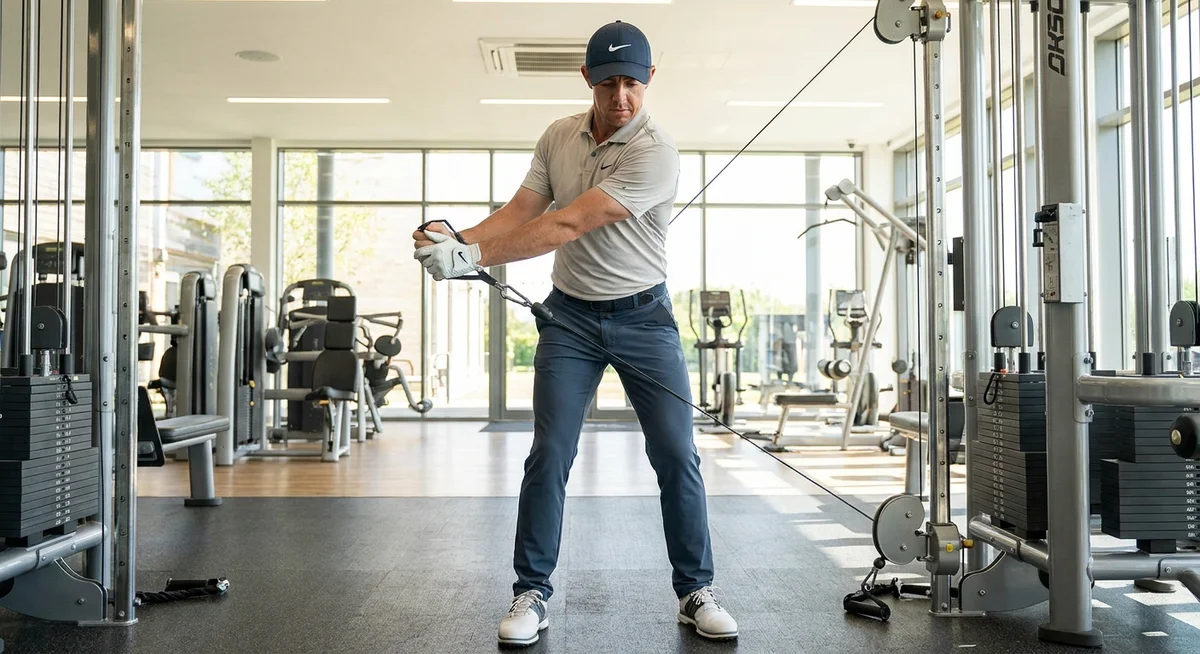
Distance off the tee is closely correlated with glute and hip strength, core stability, and shoulder mobility. A gym program built around hip hinges (Romanian deadlifts, kettlebell swings), rotational cable work, and single-leg exercises does more for your game than hours on a hitting mat. Protein powder makes that training stick: without adequate protein, the muscle damage from heavy lifts simply doesn't rebuild into stronger fibres at the rate your program demands.
If you're newer to strength training and want a foundation before adding performance nutrition, the beginner's guide to protein powder for strength training covers the core principles without assuming you're an elite athlete.
For golfers over 40, protein becomes even more important. After 40, the body's anabolic response to protein blunts slightly, meaning you need a higher per-serve dose (at least 35 to 40 g rather than 25 g) to trigger the same muscle-building signal. The article on slowing muscle loss after 40 explains the science and practical adjustments in detail.
Frequently asked questions
Can I bring a protein shake on the golf course?
Yes. A pre-mixed shake in a shaker bottle or a sachet of powder you can mix at the 9th hole turn is completely practical. Keep it light (one scoop, 20 to 25 g of protein) and pair it with something carbohydrate-based like a muesli bar. Avoid high-fat shakes mid-round as fat slows digestion and can cause discomfort during the back nine.
Will building muscle bulk slow my swing?
This is one of the most persistent myths in golf. Targeted strength training builds functional muscle in the hips, glutes, and core without adding the kind of upper-body bulk that restricts your shoulder turn. Elite tour players are now among the most muscular athletes in professional sport, and their swings are faster than ever. Protein supports that muscle quality, not bulk for its own sake.
How does protein support focus during a long round?
Amino acids are precursors to neurotransmitters including dopamine and serotonin, both of which influence focus, mood stability, and decision-making. Keeping blood amino acid levels stable across four hours of play (through adequate pre-round nutrition and a mid-round snack) helps you avoid the mental fade that typically strikes on the back nine. Protein combined with slow-release carbohydrates is the practical way to achieve this.
Is there a protein type to avoid for golfers?
Steer clear of very high-sugar mass gainer formulas unless you are genuinely underweight and trying to add overall bodyweight. Most recreational golfers don't need the extra 700 to 1,000 calories these products deliver. Stick to a clean protein powder with a short ingredient list, and manage your overall calorie intake through food rather than supplements.
Find the best protein powder for your goals Our full guide ranks the top options available in Australia with honest, no-filler advice.