Protein Powder and Body Composition: How to Shift Your Fat-to-Muscle Ratio

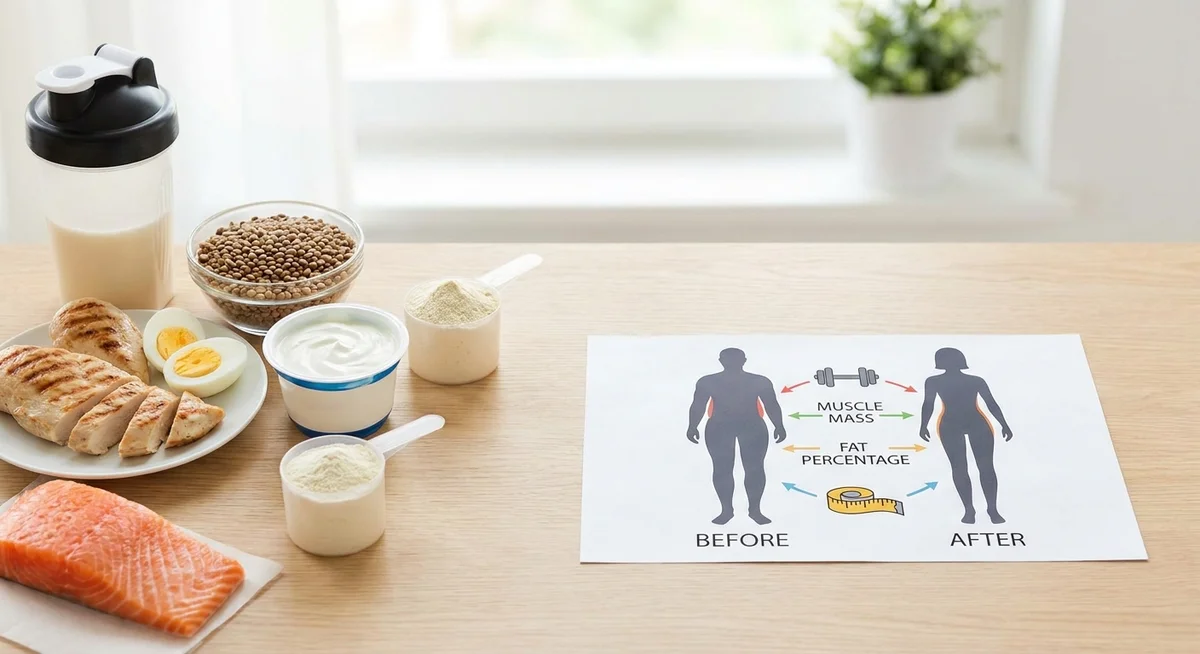
Body composition describes the ratio of fat mass to lean mass in your body. You can lose weight on the scale and still end up with a worse fat-to-muscle ratio if you lose muscle along the way. Protein powder, used strategically, is one of the most practical tools for shifting that ratio in the right direction: less fat, more muscle, or at minimum, muscle preserved while fat drops.
Key takeaways
- Body composition is about fat versus muscle, not just total weight on the scale.
- High protein intake is the single most evidence-backed dietary strategy for preserving muscle during fat loss.
- Protein powder helps you hit your daily target without excess calories from whole food sources alone.
- Timing matters less than total daily intake, but strategic use around training does provide an edge.
- Different protein sources suit different goals and dietary preferences.
Why does protein matter so much for body composition?
Protein provides amino acids, which are the raw material your body uses to build and repair muscle tissue. When you are in a calorie deficit (the condition required to lose fat), your body looks for fuel from multiple sources, including muscle. Keeping protein intake high signals your body to protect that muscle while it burns through fat stores instead. Research consistently shows that higher protein diets produce better body composition outcomes than lower protein diets at the same calorie level.
A 2012 study published in the American Journal of Clinical Nutrition found that participants eating roughly 2.4 g of protein per kilogram of bodyweight lost significantly more fat and retained more lean mass than those eating 1.2 g/kg, despite both groups being in a calorie deficit. The difference was not in calories; it was in protein.
How much protein do you actually need to shift body composition?
For most people aiming to lose fat while keeping muscle, a target of 1.6 to 2.4 g of protein per kilogram of bodyweight per day covers the evidence-based range. If you weigh 80 kg, that is 128 to 192 g of protein daily. Hitting that number from whole food alone, while staying in a calorie deficit, is genuinely difficult. A chicken breast has around 30 g. Two eggs provide about 12 g. The numbers add up slowly.
This is where protein powder becomes practical rather than optional. A single serve typically delivers 20 to 30 g of protein for 100 to 130 calories, with minimal fat and carbohydrate. It fills the gap without filling your calorie budget.
For a deeper look at the numbers, our guide to daily protein requirements breaks down targets by goal, bodyweight, and training status.
Which protein type works best for body composition goals?
Not all protein powders behave identically when body composition is your focus. Here is how the main options compare.
| Protein Type | Speed of Absorption | Best Use Case | Satiety Effect |
|---|---|---|---|
| Whey Isolate | Fast (60-90 min) | Post-training muscle repair | Moderate |
| Whey Concentrate | Moderate (2-3 hrs) | General daily use | Moderate |
| Casein | Slow (5-7 hrs) | Before bed, between meals | High |
| Pea Protein | Moderate | Plant-based daily use | Moderate-High |
| Soy Protein | Moderate | Plant-based, complete amino profile | Moderate |
For body composition specifically, whey isolate is the most studied and consistently well-performing option. It is high in leucine, the amino acid that most directly triggers muscle protein synthesis. Casein is worth adding at night because its slow digestion keeps amino acid levels elevated for hours, reducing overnight muscle breakdown.
If you are comparing whey types, our breakdown of whey isolate vs concentrate covers what the processing difference actually means for your results.
How to build protein powder into a body composition strategy
Protein powder works because it makes hitting your daily protein target easier. But where you place those serves through the day does matter for body composition outcomes.
What works
- One serve after resistance training to kickstart muscle repair
- A casein serve before bed to reduce overnight muscle breakdown
- A mid-morning or mid-afternoon serve to distribute protein evenly across four to five meals
- Mixing powder into high-volume, low-calorie meals (oats, yoghurt, smoothies) to increase satiety
What doesn't
- Relying on protein powder as your only protein source (whole food matters too)
- Drinking shakes in addition to a diet already hitting your protein target (extra calories without benefit)
- Choosing a powder with added sugars, maltodextrin, or heavy creamers that push the calorie count up
- Ignoring total calorie intake and expecting protein alone to drive fat loss
The distribution of protein across the day matters because muscle protein synthesis responds to each individual meal. Research from the University of Texas found that 20 to 40 g of protein per meal is roughly the effective range for stimulating muscle repair, with diminishing returns above that per sitting. Four serves spread across the day outperforms two large ones eaten close together.
Does protein powder help directly with fat loss?
Protein does not burn fat directly. What it does is protect muscle during a calorie deficit, raise your resting metabolic rate (muscle burns more energy at rest than fat does), and reduce hunger through its effect on satiety hormones like GLP-1 and PYY. All three of those mechanisms contribute to better body composition outcomes over time.
If you are running a calorie deficit and training, the protein powder is doing two jobs: fuelling muscle repair after sessions, and keeping you full enough to stick to your calorie target. Both matter. The combination of a modest deficit, resistance training, and 1.6 to 2.4 g/kg of protein daily is the most well-supported approach in the research for recomposing your body.
For more on how protein fits into a fat loss phase, our guide on protein powder in a calorie deficit covers the practical setup in detail.
Frequently asked questions
Can you build muscle and lose fat at the same time?
Yes, in certain conditions. People who are new to training, returning after a break, or carrying a significant amount of body fat can often build lean mass and lose fat simultaneously. This is called body recomposition. It becomes harder as you become more trained. High protein intake and consistent resistance training are both required; protein powder makes hitting the protein target significantly easier during this process.
How many protein shakes per day is too many?
There is no hard ceiling, but protein powder should fill the gap between what whole food provides and what your daily target requires. Most people find one to two serves per day is enough. Whole food sources provide fibre, micronutrients, and other compounds that powders do not. Using protein powder to replace meals entirely rather than supplement them is rarely a good long-term approach.
Will protein powder make women bulky?
No. Muscle growth requires a calorie surplus, years of progressive resistance training, and hormonal conditions that most women do not have in the same quantities as men. Protein powder in a deficit, or even at maintenance, supports muscle retention and body tightening, not unwanted size gains. The fear of bulking is one of the most persistent and least evidence-based concerns in fitness.
Does the brand or flavour of protein powder affect body composition results?
Brand and flavour do not directly affect results. What matters is the protein content per serve, the amino acid profile (particularly leucine), and the absence of excessive added sugars or fillers. A cheaper powder with 25 g of quality protein per serve will produce the same body composition outcome as an expensive one with the same spec. Read the label, not the marketing.
Find the right protein for your goalOur buying guide walks you through every type, who each suits, and what to look for on the label.