Pre-Workout vs Post-Workout Protein: What the Research Actually Says

The "anabolic window" idea, that you must drink a protein shake within 30 minutes of your last rep or your gains evaporate, has sold a lot of products. It has also been tested thoroughly, and the picture that emerges is more nuanced and, for most people, more forgiving than the marketing suggests. Whether you take your protein before or after training matters less than whether you are getting enough total daily protein and training hard enough to give your muscles a reason to grow.
Key takeaways
- Total daily protein intake is the strongest predictor of muscle growth, not timing alone.
- The "anabolic window" is real but wider than 30 minutes: research points to a 3 to 5 hour window around your session.
- Pre-workout protein can be just as effective as post-workout protein for stimulating muscle protein synthesis.
- Fasted training may slightly increase the benefit of an immediate post-workout dose.
- Slow-digesting proteins (casein) suit pre-sleep; fast-digesting proteins (whey isolate) suit around-workout use.
What does "the anabolic window" actually mean?
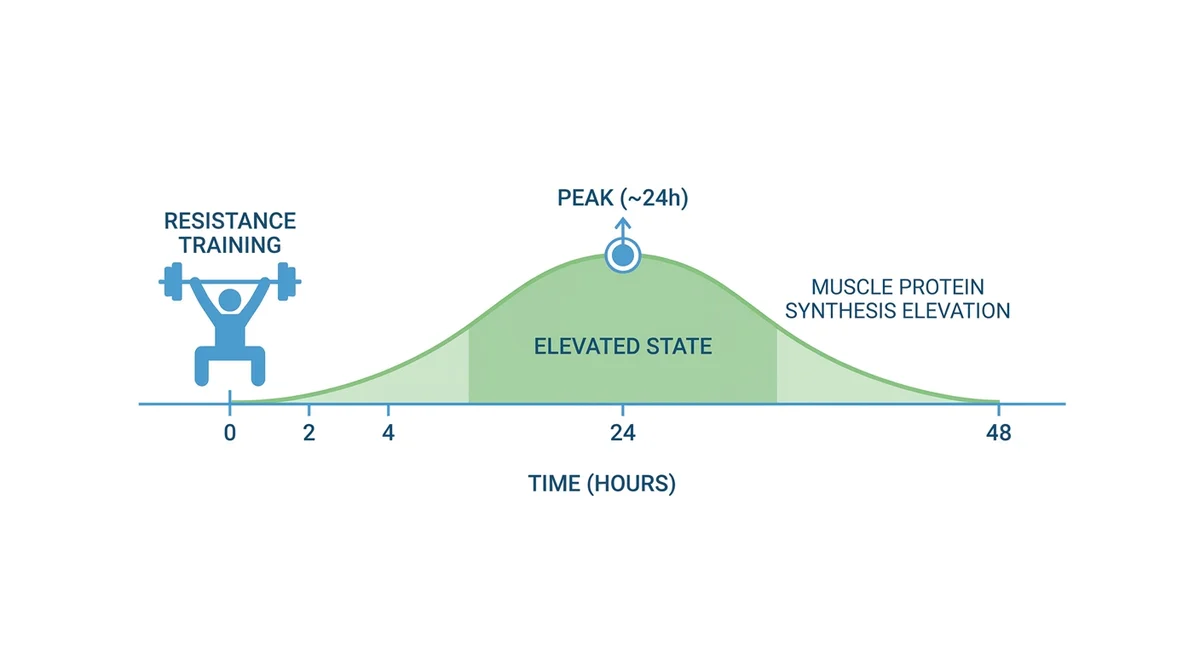
Muscle protein synthesis (MPS), the process your body uses to build and repair muscle tissue, is elevated for several hours after resistance training. Early research on this effect, much of it conducted on fasted subjects, found that consuming protein immediately after training produced meaningfully better MPS responses than waiting. That finding stuck in gym culture and became the 30-minute rule.
Later, better-controlled studies complicated things. A landmark 2013 meta-analysis by Schoenfeld and colleagues found that when researchers accounted for total daily protein intake, the timing advantage shrank considerably. A 2017 follow-up study by the same group, specifically designed to test timing independent of total intake, found no statistically significant difference between a group that consumed protein immediately pre-workout and a group that consumed the same dose immediately post-workout. Both groups gained similar amounts of muscle over 10 weeks.
The more current view: the window is real, but it spans roughly 3 to 5 hours around a session, not 30 minutes. If you ate a protein-containing meal two hours before training, you are likely still inside it when you finish.
Is pre-workout protein better, post-workout, or does it not matter?
For most people training in a fed state (meaning they ate a meal containing protein within 2 to 3 hours before training), the pre/post distinction is largely academic. What shifts the calculation:
| Scenario | Best timing approach | Why |
|---|---|---|
| Trained fed (ate 1-3 hrs before) | Post-workout within 2 hours | Pre-workout meal already covers the window; post-workout tops up the dose |
| Training first thing, fasted | Post-workout immediately | No pre-workout meal to rely on; muscle is hungry for amino acids |
| Long training session (90+ min) | Pre-workout or during | Limits muscle protein breakdown during the session itself |
| Two-a-days or back-to-back sessions | Immediately post first session | Recovery window is compressed; speed of delivery matters more |
| Goal: muscle gain on a high volume program | Pre + post (split the dose) | Two MPS pulses are better than one; 20-40g each is a practical split |
How much protein do you actually need around a workout?
The dose that maximally stimulates MPS in most adults falls between 20g and 40g of high-quality protein per serving. Younger, lighter people tend toward the lower end; older adults and heavier lifters toward the upper end, partly because MPS becomes less sensitive to amino acids with age (a phenomenon called anabolic resistance). Going above 40g in a single sitting does not appear to be harmful, but the extra protein is increasingly oxidised for energy rather than directed to muscle building.
Protein quality matters here too. Whey and egg white protein score highest on leucine content, and leucine is the amino acid that most directly triggers MPS. Plant proteins generally need a slightly larger dose, or a blend of complementary sources, to deliver an equivalent leucine stimulus. If you rely on plant protein, aim for the upper end of the 20-40g range around training. Our guide to getting complete protein from plants covers this in detail.
Which protein type works best around workouts?
Digestion speed affects how quickly amino acids reach your muscles, which is why whey isolate became the go-to around-workout protein. It digests faster than concentrate, casein, or most plant proteins. That said, the practical difference between a whey isolate shake and a whey concentrate shake is small for most recreational lifters. The bigger gap is between fast proteins (whey, egg white) and slow proteins (casein, whole food meals).
Fast-digesting proteins
- Whey isolate: highest leucine, fastest absorption
- Whey concentrate: slightly slower, often better value
- Egg white protein: complete amino acid profile, moderate digestion speed
- Best for: immediately around training
Slow-digesting proteins
- Casein: forms a gel in the stomach, releases amino acids over 5-7 hours
- Whole food protein sources: digestion slowed by fat, fibre, and food matrix
- Plant blends: generally moderate speed, varies by source
- Best for: pre-sleep, meals, or when there is plenty of time before training
For the widest view of how different protein sources compare across protein content, digestibility, and price, the best protein powder guide for Australia is a good starting point. And if you want to understand how protein content is calculated on a label, the nutrition label reading guide explains what to check.
The bottom line on timing
Optimising timing is a second-order problem. Getting your total daily protein intake right, roughly 1.6g to 2.2g per kilogram of bodyweight for people doing regular resistance training, is the first-order problem. If you are hitting that target consistently and training hard, whether you drink your shake 20 minutes before or 45 minutes after is unlikely to change your results in any measurable way.
That said, if you train fasted, have long sessions, or are doing two sessions in a day, timing matters more and an immediate post-workout dose is the right call. For everyone else: get the protein in, get enough of it, and spend your mental energy on the training itself.
Find a protein powder worth using around your workoutsOur vanilla protein powder guide covers what to look for and what to avoid on the label.Frequently asked questions
Does it matter if I take protein before or after my workout?
For most people training in a fed state, no. Both pre-workout and post-workout protein produce similar muscle-building results when total daily intake is the same. The exception is fasted training, where immediate post-workout protein is more important because there is no pre-workout meal already in your system providing amino acids.
How long is the anabolic window actually open?
Research suggests the elevated muscle protein synthesis window lasts 3 to 5 hours around a resistance training session, not the 30-minute window often cited in gym culture. If you ate a protein-containing meal within 2 to 3 hours before training, you are very likely still inside the window when you finish your session.
How much protein should I take around a workout?
Most research points to 20g to 40g of high-quality protein per serving as the dose that maximally stimulates muscle protein synthesis. Younger and lighter people respond well to 20-25g; older adults and heavier lifters benefit from being closer to 40g. Going higher is not harmful but does not provide additional MPS benefit.
Is whey protein really better than other proteins around a workout?
Whey has a high leucine content and digests quickly, which are both useful properties around training. However, the practical advantage over egg white protein or a well-formulated plant blend is modest for most people. The bigger factor is getting the dose right. If you are lactose intolerant or prefer plant protein, a quality blend at a slightly higher dose will perform comparably.